
How to count points in Qwirkle
Last updated November 23, 2026
The quick answer
In Qwirkle, you score one point for every tile in a line you create or add to, including tiles already on the table. A tile that belongs to two lines counts in both. A completed line of six, all one color or all one shape, is a Qwirkle: 6 points for the tiles plus a 6-point bonus, so 12 in total. When the bag is empty, the first player to go out adds 6 points and the game ends. The highest score wins.
The short version
- A line scores 1 point per tile in it after your play, including tiles that were already there.
- A tile that sits in two lines is counted once in each line.
- A Qwirkle (a line of six) scores 12 points: 6 for the tiles plus 6 bonus.
- Trading tiles with the bag uses your whole turn and scores 0.
- When the bag is empty, the first player to play their last tile adds 6 points and ends the game. The highest score wins.
Qwirkle scoring at a glance
| What happens | What it does to the score |
|---|---|
| You create or add to a line | 1 point for each tile in that line, including tiles already there |
| A tile that is part of two lines | It counts in both lines |
| A line of six (a Qwirkle) | 12 points: 6 for the tiles plus 6 bonus |
| Two lines of six in the same turn | 12 points for each of those lines |
| Trade tiles instead of playing | 0 points for that turn |
| First player to play their last tile once the bag is empty | 6 extra points, and the game ends |
What each play does to your score
You score the whole line
The basic rule is short, and it is the one people get wrong. When you create a line, or add to one, you score one point for every tile in that line after your play. That includes tiles other people already placed. Add one tile to a line of three and you score 4, not 1. The official rules say it in those words: you count the blocks that were already in the line. All the tiles you play on a turn must share one color or one shape, and they must belong to the same line. They do not have to touch each other. A line is all one color or all one shape, with no duplicates: a line of squares can only have one blue square, and a line can never be longer than six tiles.
A tile can score in two lines
A tile sits in a row and in a column at the same time. If the tile you just played belongs to both, you count both lines, and that tile is counted once in each. The official rules put it this way: one block can score two points if it is part of two different lines. This is where a single tile often beats a longer play. Add one tile that takes a color line from three to four and a shape line from two to three, and you score 4 + 3 = 7.
A Qwirkle is worth 12 points
A Qwirkle is a line of six: all six colors of one shape, or all six shapes of one color. That line scores 6 points for its six tiles, plus a 6-point bonus, so 12 points in total. People sometimes write down only the bonus, or only the six tiles. The line is worth both. The official rules do not use the name "double Qwirkle". The same rule still applies if one play completes two lines of six: each of those lines scores 12, so 24 from the two lines, plus any other line you also added to.
Trading tiles scores nothing
If you cannot play, or you would rather change your hand, you may trade some or all of your tiles for tiles from the bag. That uses your whole turn. You score 0. After you have drawn the same number of tiles, the ones you gave up go back into the bag. You cannot trade more tiles than are left in the bag.
How the game ends
When there are no tiles left to draw, play goes on, but nobody refills their hand. The first player to play their last tile scores 6 extra points and the game ends. Add that bonus on top of whatever the last play was worth. The highest total wins.
Sources
Qwirkle is a trademark of its owner. Scory is not affiliated with or endorsed by the trademark owner.
How to count a turn
Do this after every turn, for the player who just played.
- 1
List the lines
After you place your tiles, list every line you created or added to.
- 2
Count every tile
Count every tile in each of those lines, including tiles already there. If a new tile sits in two lines, count it in both.
- 3
Add the Qwirkle bonus
If a line now has six tiles, add 6 bonus points for that Qwirkle. That line totals 12.
- 4
Write down the turn total
Write down the turn total. If the bag is empty and you just played your last tile, add 6 more.
A worked example with two players
Ana and Ben play with the classic tiles. The numbers follow the official scoring rule, not a copy of the sample board in the booklet.
- Ana starts with three red tiles, each a different shape: a circle, a square and a diamond, in one line. The new red line has 3 tiles: 3 points. Ana 3, Ben 0.
- Ben plays three squares in a column under Ana's red square: a blue square, a yellow square and a green square. The square line now has 4 tiles, counting Ana's red square: 4 points. Ana 3, Ben 4.
- Ana plays a blue circle so that it touches Ben's blue square and her own red circle. She has made a blue line of 2 and a circle line of 2: 2 + 2 = 4 points. Ana 7, Ben 4.
- Ana adds three red tiles to the end of her red line: a clover and the two stars, the shapes it was missing. The line now has all six shapes in red: a Qwirkle. No other line touches those three tiles, so she scores 6 for the tiles plus 6 bonus: 12 points. Ana 19, Ben 4.
- The bag is empty. Ana plays her last tile, a yellow circle, under her blue circle and next to Ben's yellow square. The circle line now has 3 tiles and the yellow line has 2: 3 + 2 = 5 points, plus 6 for going out: 11 points. Ana 30, Ben 4.
| Turn | Ana | Ben |
|---|---|---|
| 1. Three red tiles | 3 | 0 |
| 2. Three squares under a red square | 0 | 4 |
| 3. One blue circle in two lines | 4 | 0 |
| 4. Three red tiles, Qwirkle | 12 | 0 |
| 5. Last tile in two lines, plus going out | 11 | 0 |
| Total | 30 | 4 |
Ana wins 30 to 4.
House rules vary. Where a value genuinely differs from table to table, this page says so rather than picking one and pretending it is universal.
Let Scory keep the running total
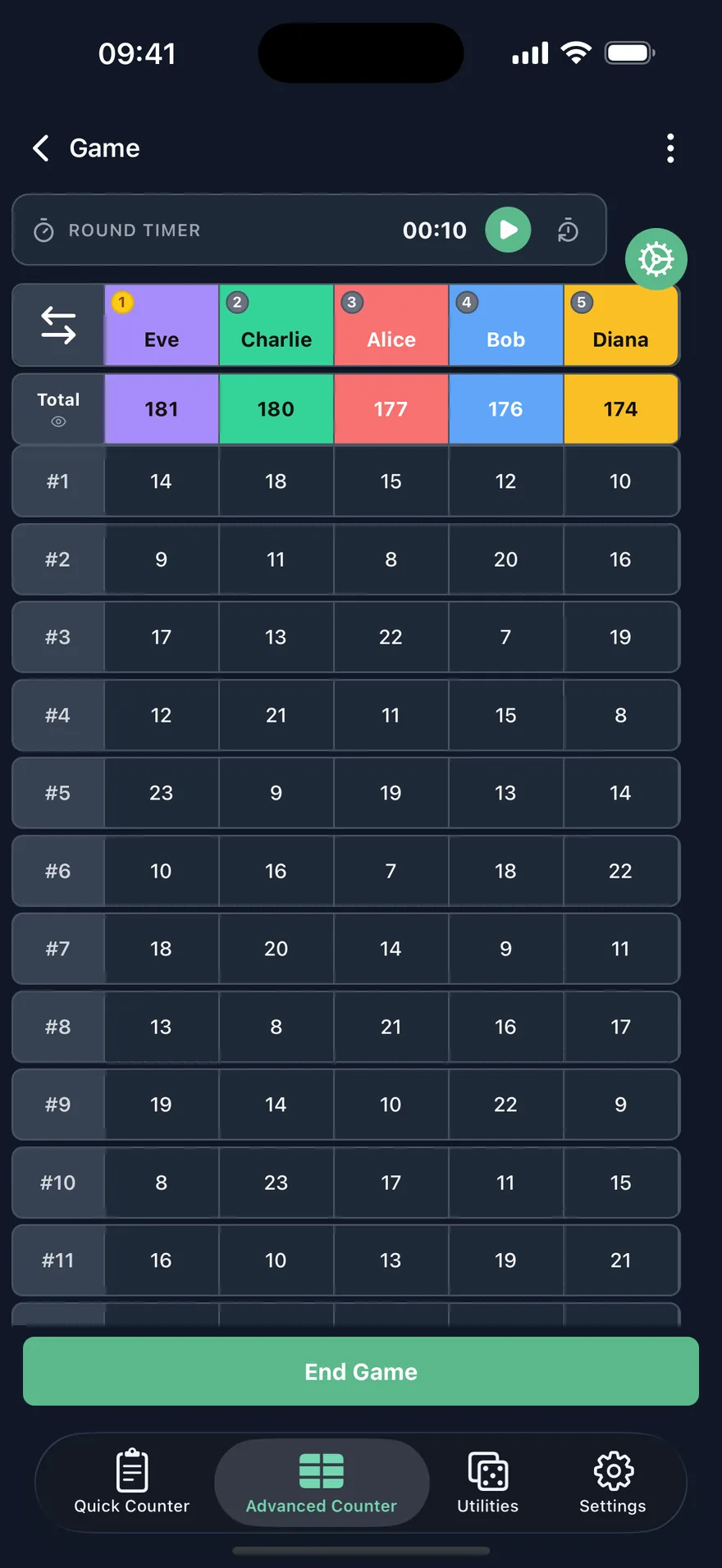
Qwirkle scores are easy to lose track of once lines start crossing. In Scory, start a Qwirkle game and type each player's points after they play. The app keeps a running total, and the highest score wins. It does not spot a Qwirkle for you: when you complete a line of six, add the 6-point bonus yourself, and add 6 more if you go out.
- A running total for each player after every play
- 2 to 4 players, as in the classic game
- Added too much? Tap the player, choose Remove and type the extra points
- Works offline, no account needed


Frequently asked questions
How do you count points in Qwirkle?
Score 1 point for every tile in each line you created or added to, including tiles already on the table. If a new tile belongs to two lines, count both. A line of six is a Qwirkle and scores 12.
How many points is a Qwirkle?
12 points: 6 for the six tiles in the line, plus a 6-point bonus.
Do you count the tiles that were already on the table?
Yes. A line is worth one point per tile in it after your play, not one point per tile you just added. Add one tile to a line of four and you score 5.
Can one tile score in two lines at once?
Yes. If the tile you played is part of a color line and a shape line, it counts once in each line.
Can you score two Qwirkles in one turn?
Yes. If one play completes two lines of six, each of those lines scores 12, so 24 from the two lines. The official rules do not give that play a special name.
Do you get points for going out first in Qwirkle?
Yes. Once the bag is empty, the first player to play their last tile scores 6 bonus points on top of that last play, and the game ends.
Do you score anything if you trade tiles?
No. Trading tiles with the bag uses your whole turn and scores 0.
Who wins a game of Qwirkle?
The player with the highest total when the game ends, which is when the bag is empty and someone has played their last tile.