
How to count points in Skyjo
Last updated August 24, 2026
The quick answer
In Skyjo, every card is worth its printed value, from -2 to 12. At the end of a round each player turns over their whole 12-card grid and adds the values up. A column of three identical cards is removed from the grid and scores nothing. The player who ended the round has their round total doubled unless they finish with the lowest score on their own. Rounds keep going until someone reaches 100 points, and the lowest total wins.
The short version
- Card values run from -2 to 12, and the five -2 cards are the only way to push a grid below zero.
- Three identical cards in the same column are removed and score 0 for that round.
- Ending the round without the lowest score on your own doubles your total for that round.
- Face-down cards still count: everything left in the grid is turned over and added up.
- The game ends after the round in which any player reaches 100 points. Lowest total wins.
Skyjo card values
| Card | Copies in the deck | Points |
|---|---|---|
| -2 | 5 | -2 each |
| -1 | 10 | -1 each |
| 0 | 15 | 0 |
| 1 to 12 | 10 of each | Face value |
The deck holds 150 cards. Only fifteen of them are worth nothing or less, which is why a clean grid is so hard to keep.
Counting a grid at the end of the round
As soon as one player has all twelve of their cards face up, every other player takes one final turn. Then everyone turns over whatever is still hidden and adds up the whole grid. There is no separate bonus and no multiplier on individual cards: a 12 costs twelve points whether you knew it was there or not, which is what makes swapping blind cards late in a round so expensive.
Columns of three cancel out
If the three cards of a column show the same value, the column is discarded immediately and scores nothing. This is the single biggest scoring lever in the game: a column of three 12s that would have cost 36 points ends up costing zero, and your grid shrinks to nine cards for the rest of the round.
- The column disappears as soon as the third matching card is revealed, not at the end of the round.
- Dumping high cards into one column beats spreading them across the grid.
- A column of three -2s is worth removing too, even though it costs you six negative points.
The doubling penalty for ending the round
The player who turns over their twelfth card ends the round, and they take a risk doing it. If they do not hold the lowest total on their own, their score for that round is doubled. Tying with another player is not enough: you need the lowest score alone. When the total is zero or negative there is nothing to double, so the penalty simply does not bite.
When the game ends
Round totals are added to a running score. The moment any player reaches or passes 100 points, the current round is finished and the game stops. The player with the lowest cumulative total wins, so Skyjo rewards keeping every round small rather than winning any single one.
Does Skyjo Action score differently?
No. Skyjo Action adds action cards that change what you can do on your turn, but the number cards keep exactly the same values, columns of three still cancel, and the end-of-round count and the doubling penalty are unchanged. If you can score classic Skyjo, you can score Skyjo Action.
How to score a round of Skyjo
Five steps, in this order. Doing the doubling before the columns is the classic way to get a round wrong.
- 1
Turn everything face up
Once the last player has taken their final turn, every remaining face-down card in every grid is revealed.
- 2
Remove any column of three
A column showing three identical values is discarded and scores nothing, including columns completed by the final reveal.
- 3
Add up each grid
Sum the face values of the cards still in front of each player. Negative cards subtract from the total.
- 4
Apply the doubling penalty
If the player who ended the round is not the sole lowest score, double their round total. Everyone else keeps theirs as it is.
- 5
Add to the running total
Write each round score onto the cumulative sheet. If nobody has reached 100, deal the next round.
A worked example
Anna turns over her twelfth card and ends the round. Here is what the three grids add up to.
| Player | Grid total | Round score |
|---|---|---|
| Anna (ended the round) | 4 | 8 (doubled) |
| Ben | 12 | 12 |
| Chloe | 3 | 3 |
Anna ended the round with 4 points, but Chloe finished on 3. Because Anna is not the sole lowest, her total is doubled to 8 and the round she tried to close costs her more than either opponent.
House rules vary. Where a value genuinely differs from table to table, this page says so rather than picking one and pretending it is universal.
Let Scory do the counting
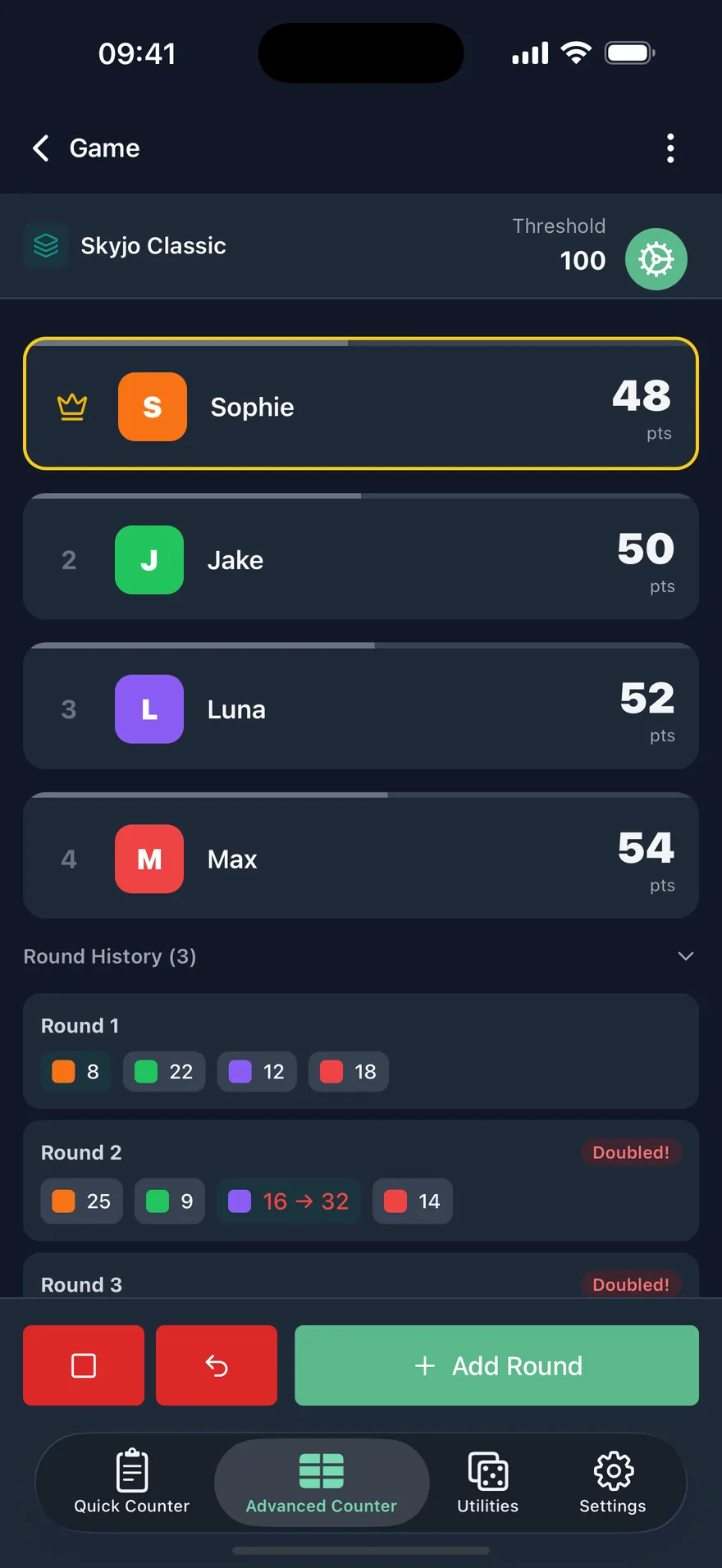
The arithmetic is easy; remembering the doubling penalty at 11pm after four rounds is not. Scory has a purpose-built Skyjo screen: tap the cards left in each grid and it works out the round, applies the penalty automatically, and keeps the running total to 100.
- A card calculator: tap each remaining card instead of adding in your head.
- The end-of-round penalty is applied for you, with the sole-lowest check built in.
- Classic and Action modes, plus manual entry if you prefer to total your own grid.
- Running scores, the 100-point finish line, and the winner called automatically.


Frequently asked questions
Do face-down cards count in Skyjo?
Yes. At the end of the round every card still in your grid is turned over and counted at face value, whether you had seen it or not.
What happens if I tie with the lowest score?
If you ended the round, a tie is not good enough: the penalty applies unless you hold the lowest total on your own, and your round score is doubled.
Is a negative score doubled?
There is nothing to double. A player who ends the round on zero or a negative total simply keeps it, so closing a round from a clean grid is the safe way to do it.
How many points end a game of Skyjo?
100. As soon as a player reaches or passes 100 points, the current round is played out and the game ends. The lowest cumulative total wins.
How many cards are in a Skyjo deck?
150: five -2s, ten -1s, fifteen 0s, and ten copies each of 1 through 12.
Does a column of three have to be removed?
Yes, it goes as soon as the third matching card is revealed. That is usually good news, but it also means a column of three -2s leaves and takes its six negative points with it.