
Phase 10 scoring: how to count points
Last updated November 17, 2026
The quick answer
In Phase 10, the player who goes out first scores 0 for the round. Everyone else adds up the cards still in their hand: 5 points for each card from 1 to 9, 10 points for each card from 10 to 12, 15 points for a Skip and 25 points for a Wild. Cards laid down on the table do not count. A low total is better, but the phase comes first. The first player to complete Phase 10 wins, and points only break a tie.
The short version
- The player who goes out scores 0 for the round.
- Everyone else scores the cards left in their hand. Cards on the table do not count.
- 1 to 9 = 5 points, 10 to 12 = 10 points, Skip = 15 points, Wild = 25 points.
- The phase comes before points. You win by completing Phase 10 first.
- If two or more players complete Phase 10 in the same round, the lowest total wins.
Phase 10 card values
| Card | Points per card | Example |
|---|---|---|
| Number cards 1 to 9 | 5 | 2, 7 and 9 left in hand = 15 |
| Number cards 10 to 12 | 10 | 10 and 12 left in hand = 20 |
| Skip | 15 | One Skip left in hand = 15 |
| Wild | 25 | Two Wilds left in hand = 50 |
| Going out (no cards left) | 0 | The round winner scores 0 |
Count only the cards still in your hand when the round ends. House rules vary: some tables count a Wild as 20. Agree on it before you start.
Who scores zero
A round ends as soon as one player goes out. To go out, you must first lay down your phase. Then you get rid of every card left in your hand, by adding them to phases on the table or by discarding your last card. Adding cards to a phase is called a hit. That player wins the round and scores 0. The round ends for everyone at that moment.
Count the cards left in your hand
Every other player adds up the cards still in their hand, using the values in the table. Only the cards in your hand count. Cards you laid down in your phase, or hit on other phases, score nothing. Write each player's points for the round and keep a running total. The lowest total is best.
The 10 phases
Each player makes the phases in order, from 1 to 10, and can make only one phase per round. If you lay down your phase, you move on to the next one in the next round, even if you did not go out. If you do not, you try the same phase again. So players can be on different phases at the same time. A set is two or more cards with the same number. A run is four or more cards in a row, like 3, 4, 5, 6. Colors do not matter, except in Phase 8.
- Phase 1: 2 sets of 3
- Phase 2: 1 set of 3 + 1 run of 4
- Phase 3: 1 set of 4 + 1 run of 4
- Phase 4: 1 run of 7
- Phase 5: 1 run of 8
- Phase 6: 1 run of 9
- Phase 7: 2 sets of 4
- Phase 8: 7 cards of 1 color
- Phase 9: 1 set of 5 + 1 set of 2
- Phase 10: 1 set of 5 + 1 set of 3
Phase first, points second
Points do not pick the winner on their own. The first player to complete Phase 10 at the end of a round wins the game, even if their total is higher than someone else's. A player on Phase 6 with 200 points is ahead of a player on Phase 4 with 50 points. Points only matter when two or more players complete Phase 10 in the same round. Then the player with the fewest total points wins.
What happens in a tie
If the players who completed Phase 10 in the same round also have the same total, they play Phase 10 again. The first of them to go out wins the game.
Skip and Wild cards
A Wild can take the place of any number or any color in a phase. You can use as many Wilds as you like, as long as the phase has at least one number card. A Skip makes another player lose their next turn. It can never be part of a phase. Both are worth a lot of points if they are still in your hand when the round ends.
Official variations
The official rules list two other ways to play. Agree on one before the game starts.
- 10 rounds: play exactly 10 rounds. Everyone moves on to the next phase each round, whether they made their phase or not. After 10 rounds, the lowest total wins.
- Fewer phases: decide before you start how many phases a player must complete to win, for example 5 or 7. All other rules stay the same, so the game is shorter.
Phase 10 is a trademark of its owner. Scory is not affiliated with or endorsed by the trademark owner.
How to score a round of Phase 10
Do this as soon as one player goes out.
- 1
Give the round winner 0
The player who went out has no cards left and scores 0 for the round.
- 2
Count each hand
Each other player counts their cards: 5 for 1 to 9, 10 for 10 to 12, 15 for a Skip and 25 for a Wild.
- 3
Add to the running total
Write down each player's points for the round and add them to their total.
- 4
Note who made their phase
Players who laid down their phase move to the next phase. The others try the same phase again next round.
A worked example: 4 players, 3 rounds
Mia, Leo, Sam and Zoe play three rounds. Each cell shows the points for that round, with the cards left in hand in brackets. The last column shows the phase each player works on next.
| Player | Round 1 | Round 2 | Round 3 | Total | Next phase |
|---|---|---|---|---|---|
| Mia | 0 (went out) | 10 (12) | 70 (no phase) | 80 | Phase 3 |
| Leo | 20 (3, 8, 11) | 0 (went out) | 10 (2, 5) | 30 | Phase 4 |
| Sam | 20 (Skip, 4) | 60 (no phase) | 25 (9, 10, 11) | 105 | Phase 3 |
| Zoe | 70 (no phase) | 30 (Wild, 6) | 0 (went out) | 100 | Phase 3 |
The three players who missed a phase still held all 10 cards. Zoe had nine cards from 1 to 9 and a Wild, so 45 + 25 = 70. Sam had eight cards from 1 to 9 and two from 10 to 12, so 40 + 20 = 60. Mia had seven cards from 1 to 9, two from 10 to 12 and a Skip, so 35 + 20 + 15 = 70. Leo has the lowest total with 30, and he is the only one on Phase 4. Missing a phase hurts twice: you stay behind and you keep a full hand of points.
House rules vary. Where a value genuinely differs from table to table, this page says so rather than picking one and pretending it is universal.
Keep Phase 10 scores in Scory
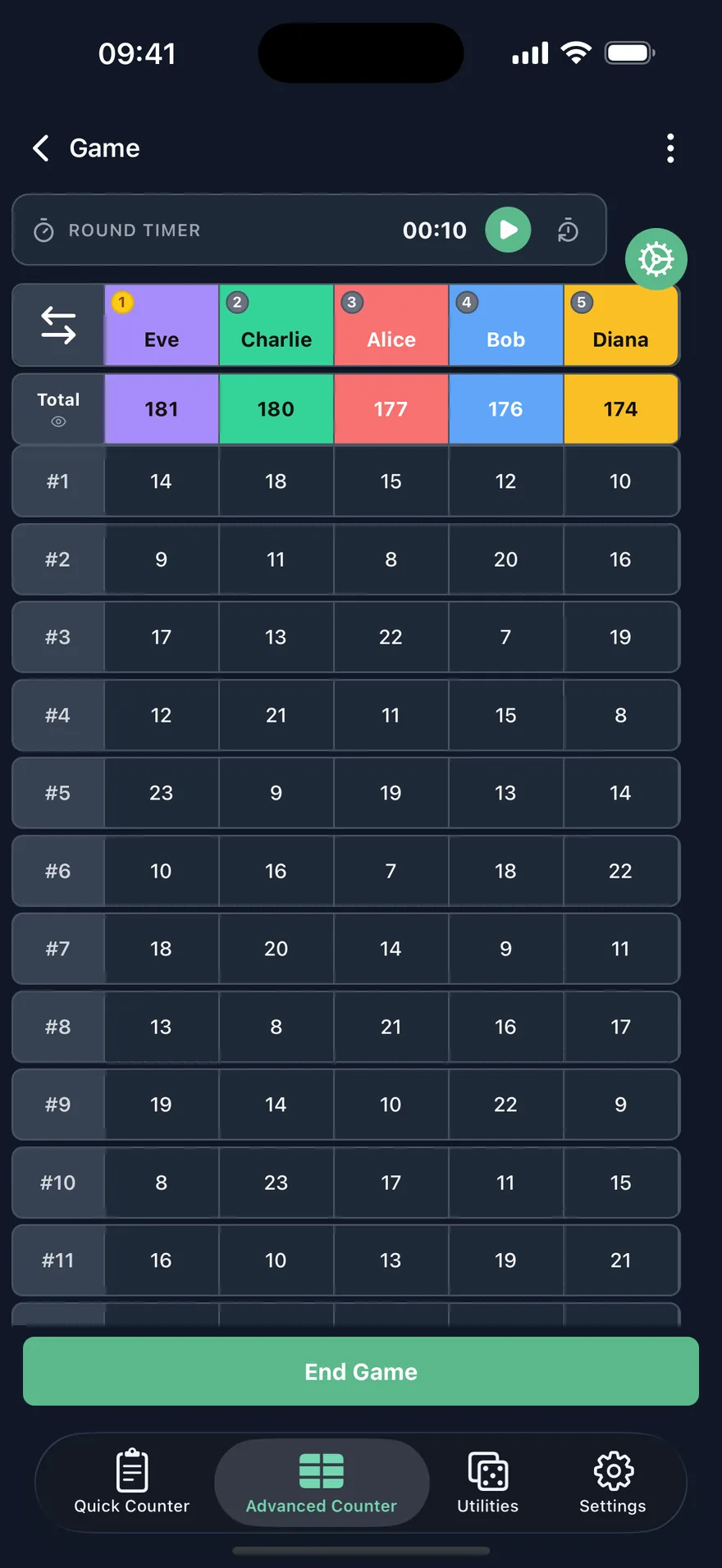
Scory has no Phase 10 mode and does not track which phase each player is on. It gives you a round-by-round score sheet. Set it so the fewest points win, then type in each player's points after every round. Scory adds up the totals for you. For the phases, write each player's phase next to their name or tick it off on paper.
- A score sheet with one line per round and a running total for each player.
- Set the game to "least points wins" so the lowest total is shown as the leader.
- Works offline and needs no account.
- Tap an earlier round to fix a score, and look back at past games in the history.


Frequently asked questions
Do laid-down cards count in Phase 10?
No. Only the cards still in your hand at the end of the round count. The cards in your phase, and any cards you hit on other phases, score nothing.
How much is a Wild card worth in Phase 10?
25 points if it is still in your hand when the round ends. House rules vary, and some tables count a Wild as 20, so agree on it before you start.
How much is a Skip card worth in Phase 10?
15 points if it is still in your hand when the round ends. A Skip can never be used in a phase.
Who wins if two players finish Phase 10 in the same round?
The player with the fewest total points. If they also have the same total, they play Phase 10 again, and the first one to go out wins.
Does the lowest score always win in Phase 10?
No. The first player to complete Phase 10 wins, even with more points. Points only decide the game when several players complete Phase 10 in the same round, or when you play the 10-round variation.
Can you play Phase 10 with 2 players?
Yes. Phase 10 is for 2 to 6 players, and the scoring is the same with 2 players.
Is there an app to count Phase 10 points?
Scory keeps the running total on a round-by-round score sheet, but it does not count your cards or track phases. Count each hand with the values above, then type in the number.