
How to score Wizard
Last updated November 12, 2026
The quick answer
In Wizard, you only score if you make your exact bid. If you take exactly the number of tricks you bid, you get 20 points plus 10 points for each trick. A bid of 0 that you make is worth 20. If you take more or fewer tricks than you bid, you lose 10 points for each trick you are off. Add each round to a running total. After the last round, the highest total wins.
The short version
- Exact bid made: 20 points plus 10 points for each trick you took.
- Bid missed: minus 10 points for each trick over or under your bid. The tricks you took add nothing.
- A bid of 0 that you make scores 20 points.
- Round 1 has one card each, round 2 has two, and so on until the 60-card deck runs out.
- Totals can drop below zero. The highest total after the last round wins.
Wizard points for each result
| Bid | Tricks taken | Round score |
|---|---|---|
| 0 | 0 | +20 |
| 1 | 1 | +30 |
| 2 | 2 | +40 |
| 3 | 3 | +50 |
| 2 | 1 | -10 |
| 0 | 2 | -20 |
| 4 | 1 | -30 |
Made bid: 20 plus 10 for each trick. Missed bid: minus 10 for each trick between your bid and the tricks you took.
Make your exact bid
Each round, every player says how many tricks they think they will win. This is their bid. The player to the left of the dealer bids first. Write all the bids down before the first card is played. At the end of the round, compare each bid with the tricks that player really took. Being close does not count. Only an exact bid earns points.
Scoring a made bid
If your tricks match your bid, you get a 20-point bonus for the right bid. You also get 10 points for each trick you took. So a bid of 3 that you make is worth 20 + 30 = 50 points. A bid of 0 that you make has no tricks to count, so it is worth 20.
Scoring a missed bid
If you take more or fewer tricks than you bid, you lose 10 points for each trick of difference. Missing by one costs 10. Missing by three costs 30. It does not matter if you were over or under. The tricks you did take give you nothing that round.
How many rounds you play
Everyone gets one card in round 1, two cards in round 2, and one more card each round after that. The game ends once the whole 60-card deck has been dealt, so the number of rounds depends on the number of players.
- 3 players: 20 rounds
- 4 players: 15 rounds
- 5 players: 12 rounds
- 6 players: 10 rounds
Trump and the last round
After dealing, turn over the top card of the cards left over. Its color is trump for that round. If it is a Wizard, the dealer looks at their hand and picks the trump color. If it is a Jester, there is no trump. In the last round every card is dealt, so there is no card to turn and no trump.
How the game ends
After the last round, look at the totals. The player with the most points wins. A total can go below zero, so keep the minus sign on the sheet. In the Amigo rules, players who tie for the most points share the win.
The plus or minus one variant
The Amigo rulebook lists an optional variant: the bids in a round must not add up to the number of tricks. In round 5, for example, the bids must total more or less than 5, so at least one player will miss. US Games lists a similar optional rule. Agree on it before you start. The standard rules have no such limit.
How to score a round of Wizard
Do this for each player at the end of every round.
- 1
Compare bid and tricks
Count the tricks the player took and check them against the bid on the sheet.
- 2
Made it? Add 20 plus 10 per trick
If the numbers match, the round score is 20 plus 10 for each trick. A made bid of 0 scores 20.
- 3
Missed it? Take away 10 per trick
If the numbers are different, the round score is minus 10 for each trick of difference.
- 4
Update the running total
Add the round score to the player's total. Totals can go below zero.
A worked example
Round 3: each player has three cards, so three tricks are played. Mia bids 2, Leo bids 2 and Sam bids 0.
| Player | Bid / tricks | Round score |
|---|---|---|
| Mia | 2 / 2 | 20 + 10 + 10 = 40 |
| Leo | 2 / 1 | -10 |
| Sam | 0 / 0 | 20 |
Mia made her bid and scores 40. Leo was one trick short, so he loses 10, even though he took a trick. Sam bid 0 and took no tricks, so he gets 20. The bids added up to 4 in a round with only 3 tricks. That is allowed in the standard rules.
House rules vary. Where a value genuinely differs from table to table, this page says so rather than picking one and pretending it is universal.
Keep the running total in Scory
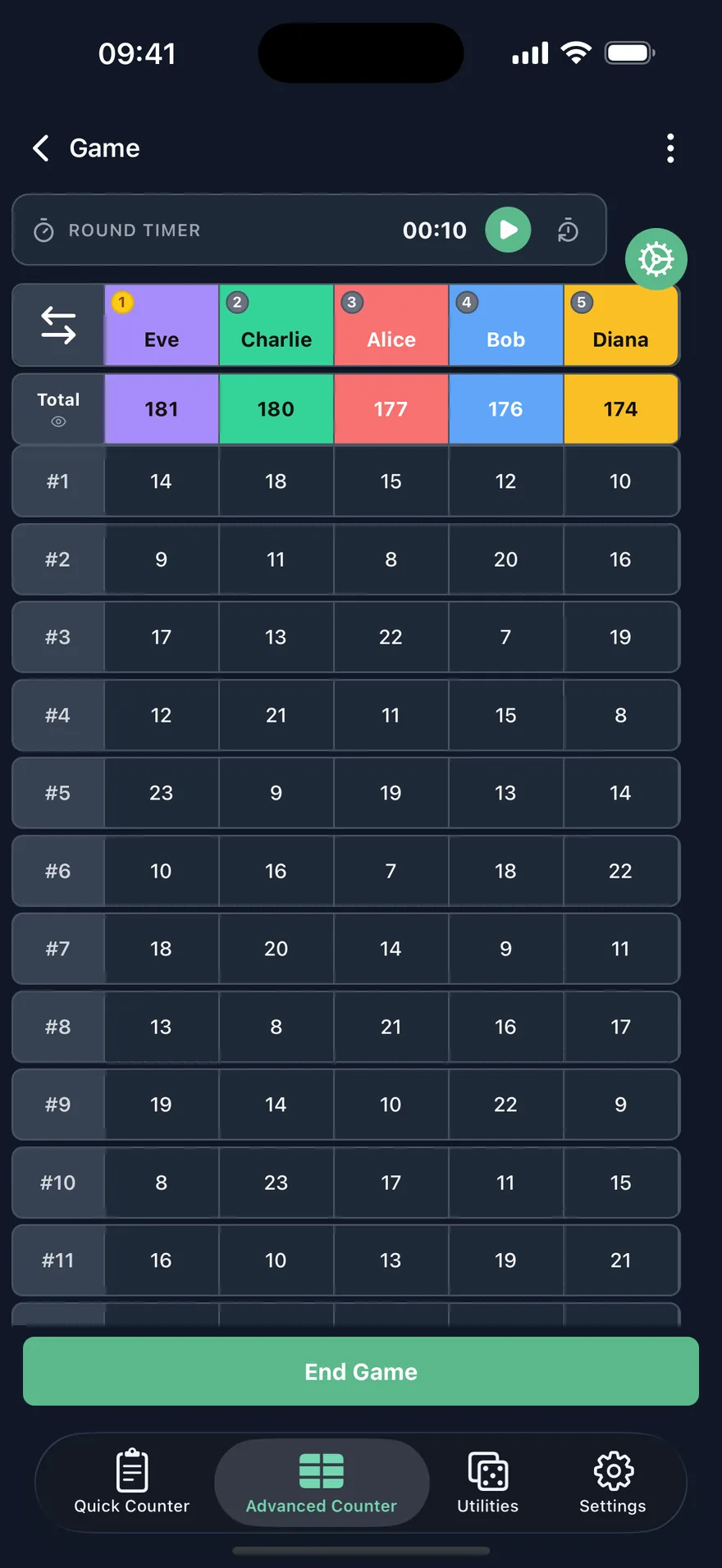
Scory has no special Wizard screen. It gives you a round-by-round score sheet. After each round, work out every player's score with the rule above, then type it in. Scory adds it to the running total, so nobody has to add up long columns by hand.
- A score sheet with one line per round and a running total for each player.
- Add or take away points, so a missed bid goes in as -10 or -30 just as easily.
- Set the number of rounds for your table: 20, 15, 12 or 10.
- Tap an earlier round to fix a score, and look back at past games in the history.


Frequently asked questions
How many points is a bid of 0 worth in Wizard?
20 points, if you take no tricks. If you take any tricks, you lose 10 points for each one.
Do you get points for your tricks if you miss your bid?
No. When you miss, the tricks you took are worth nothing. You lose 10 points for each trick you are over or under your bid.
How many rounds are there in Wizard?
It depends on the number of players: 20 rounds with 3, 15 with 4, 12 with 5 and 10 with 6. By then the whole 60-card deck has been dealt.
Can your score go below zero in Wizard?
Yes. Missed bids take points away, so a total can drop below zero. Keep playing: one good round can bring back 40 or 50 points.
Can the bids add up to the number of tricks?
Yes, in the standard rules. The bids can add up to more, fewer or exactly the number of tricks. The Amigo rulebook has an optional variant where the total must not match. Agree on it before the game.
What happens if there is a tie in Wizard?
In the Amigo rules, tied players share the win. The US Games FAQ suggests a tie-breaker instead: deal ten cards to each tied player and play one more round of ten tricks.
Is there a calculator for Wizard points?
Scory keeps the running total for you, but you work out each round score yourself. Use 20 plus 10 per trick for a made bid and minus 10 per trick for a missed one, then enter that number.