
How to score darts (501 and 301)
Last updated August 24, 2026
The quick answer
In 501 and 301 you start on the target number and subtract the value of every dart until you land on exactly zero. The outer ring doubles a segment, the thin inner ring trebles it, the outer bull is 25 and the bullseye 50. Almost every format asks you to finish on a double. Going below zero, leaving yourself on 1, or hitting zero without a double is a bust: the three darts are wiped and your score goes back to where the turn started.
The short version
- You count down, not up: every dart is subtracted from what is left.
- Outer ring doubles, inner ring trebles, outer bull 25, bullseye 50.
- The maximum with three darts is 180: three trebles on the 20.
- A bust voids the whole turn, not just the dart that caused it.
- 170 is the highest possible checkout: treble 20, treble 20, bullseye.
What each part of the board is worth
| Area of the board | Value | Example |
|---|---|---|
| Large segment | Face value | 20 scores 20 |
| Outer ring (double) | Twice the segment | Double 16 scores 32 |
| Inner ring (treble) | Three times the segment | Treble 20 scores 60 |
| Outer bull | 25 | Green ring around the centre |
| Bullseye | 50, counts as a double | Can finish a leg |
| Outside the wire | 0 | The dart still counts as thrown |
The bullseye counts as a double 25, which is why a game can be finished on it.
Counting down from 501
Each player throws three darts per turn and subtracts the total from what they had left. Start on 501, throw 60, 60 and 20, and you are on 361. There is no bonus for a big turn and no penalty for a bad one; the only number that matters is what remains, which is why players talk about being on 40 or on 170 rather than about the points they have scored.
Finishing on a double
In the standard double-out format the dart that takes you to zero has to land in the outer ring, or in the bullseye, which counts as a double 25. That is why players aim to leave themselves an even number: on 32 you can throw at double 16, miss into the single, and still have double 8 waiting. Leave yourself on 39 and you are in for a much worse time.
- Double out is the tournament standard and the default in most pub games.
- Straight out lets any dart finish, and is common in casual games and on some machines.
- Double in, where the first scoring dart must be a double, is a variant you agree beforehand.
The bust rule
Three things bust a turn: scoring more than you had left, landing exactly on 1, and reaching zero with something other than a double. All three have the same consequence. The turn ends immediately, every dart thrown in it is cancelled, and your score returns to what it was before you threw. Sitting on 32 and hitting a treble 20 leaves you on 32 again, not on minus 28.
Checkouts and bogey numbers
A checkout is a finish taken in one turn. The highest is 170, treble 20 twice then the bullseye, and everything from 2 to 170 can be checked out except seven numbers: 169, 168, 166, 165, 163, 162 and 159. Those are the bogey numbers, impossible in three darts, and good players avoid leaving themselves on them.
- 170: treble 20, treble 20, bullseye. The big fish.
- 167: treble 20, treble 19, bullseye.
- 160: treble 20, treble 20, double 20.
- 40: double 20, the most common finish in the game, and the reason 40 is a good leave.
301, 501, 701 and legs
The rules are identical whatever the starting number; only the length changes. 301 is a quick game and is often played double in as well as double out, 501 is the standard for singles matches, and 701 suits pairs. Matches are counted in legs and sets rather than points: first to a set number of legs takes the match.
How to score a turn at darts
Score the whole turn, then check it against the rules. That order is what keeps a bust from being written down by mistake.
- 1
Add the three darts
Read each dart as its segment times the ring it landed in, and add the three together.
- 2
Subtract from the remaining score
Take the turn total off what the player had left. That new number is what they are on.
- 3
Check for a bust
Below zero, exactly 1, or zero without a double: the turn is void and the score reverts.
- 4
Check the finish
Exactly zero with a double or the bullseye ends the leg there, and any unthrown darts are not needed.
- 5
Pass the darts on
Write the remaining score next to the player and hand over to the opponent.
A worked leg
One player from 501, including the bust that costs a whole turn.
| Turn | Darts thrown | Left |
|---|---|---|
| 1 | T20, T20, 20 = 140 | 361 |
| 2 | T20, T19, T20 = 177 | 184 |
| 3 | T20, T18, 30 = 144 | 40 |
| 4 | Single 20, single 20 = bust | 40 |
| 5 | Double 20 = checkout | 0 |
Turn 4 is the one worth studying. Two single 20s took the player to zero without a double, so the turn busted and the score went straight back to 40. The leg was won on the next visit with a single dart.
House rules vary. Where a value genuinely differs from table to table, this page says so rather than picking one and pretending it is universal.
Let Scory do the counting
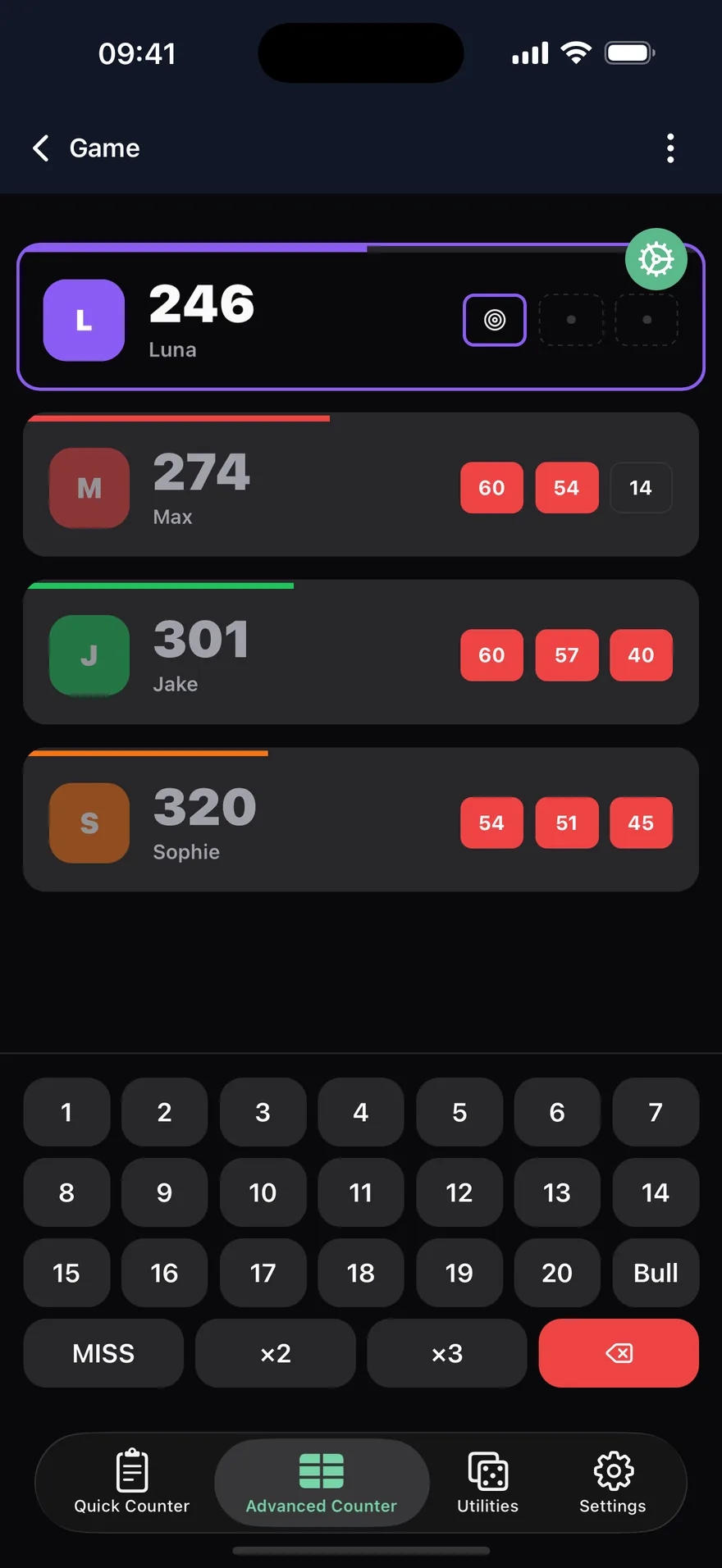
Subtracting 177 from 361 in your head, three darts at a time, while also watching for a bust, is how casual darts nights end in a recount. Scory has a purpose-built darts keypad that does the subtraction and the rule-checking as you throw.
- A real darts keypad: 1 to 20 plus bull, with double and treble multipliers.
- Busts detected and reverted automatically, so the score never drifts.
- 301, 501, 701 or a custom start, with double out or straight out.
- Throw-by-throw history, so you can see exactly where the leg was lost.


Frequently asked questions
What is the highest score with three darts?
180, from three darts in the treble 20. Three bullseyes score 150, which is why the 20 rather than the centre is the target for scoring.
What is the highest checkout in darts?
170: treble 20, treble 20, bullseye. Nothing above it can be finished in three darts, and 169, 168, 166, 165, 163, 162 and 159 cannot be finished at all.
What counts as a bust in darts?
Scoring more than you had left, leaving yourself on exactly 1, or reaching zero without a double. The turn is voided and your score goes back to what it was before the turn.
Can you finish on the bullseye?
Yes. The bullseye is 50 and counts as a double 25, so it is a legal checkout in a double-out game.
Do you have to start on a double in 501?
Not in the standard game: 501 is straight in and double out. Double in is a variant, more common in 301, and it has to be agreed before the leg starts.
What is a three-dart average?
The points scored divided by the number of turns taken. A 60 average is a strong club player; professionals sit around 95 to 100.